Notes
Texts offering further readings of selected photographic works.
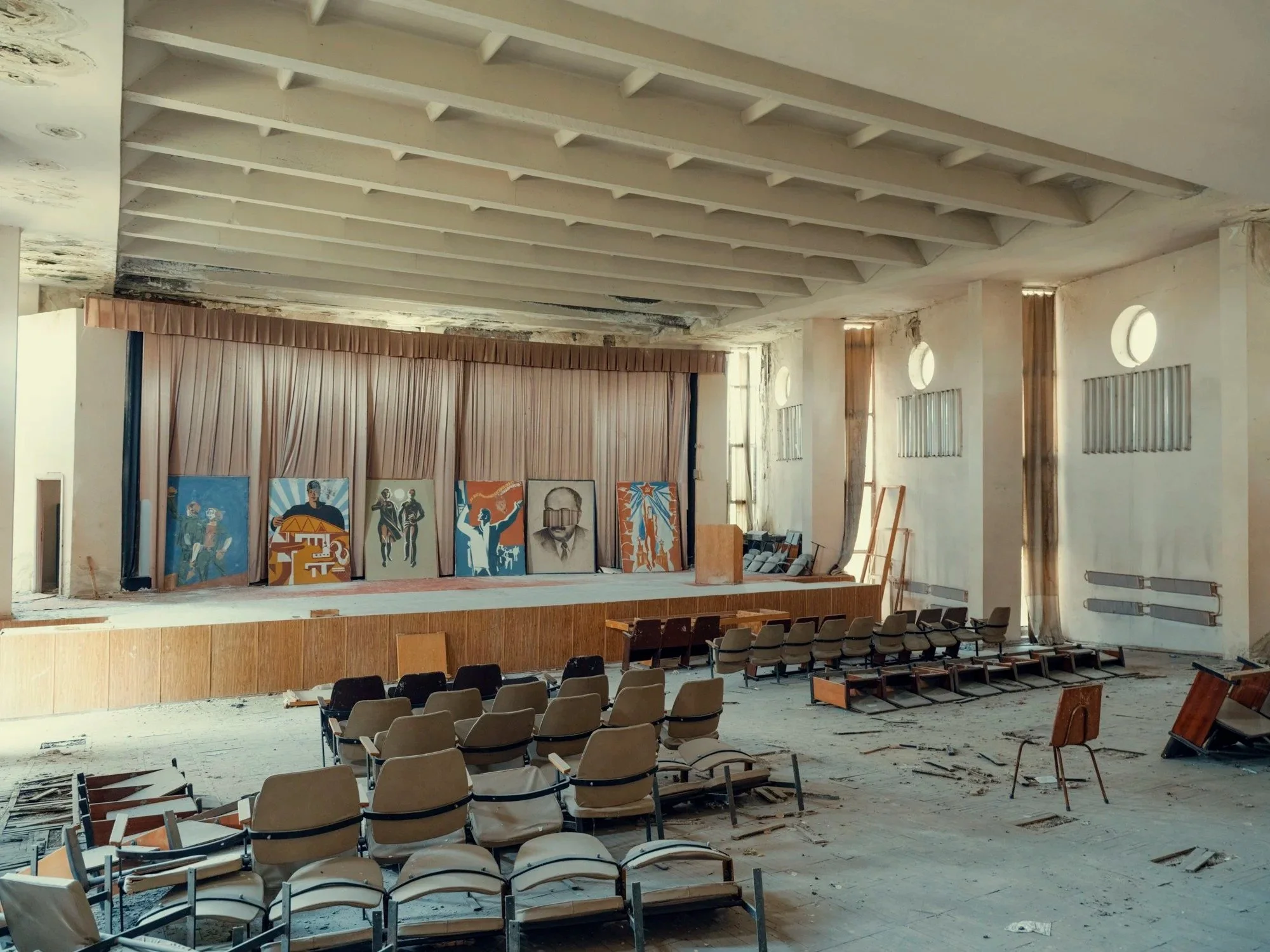
Soviet-Era Paintings, Cultural House of the Institute for Physical Research, Ashtarak, Armenia, 2024
I pushed the door of the Institute of Ashtarak into the heart of this Armenia where the mountains still seem to bend under the Soviet silence. Beyond the laboratories and equations, I discovered a place frozen in an in-between time: its House of Culture.
When I enter this conference room, the air is heavy with this century-old dust that stings the throat, and yet, the scenery seems to be waiting for a signal for the session to resume.
On the stage, aligned like fallen sentinels, six paintings from the Soviet era seemed to stare at me in the darkness of the deserted room. In the center, Lenin. Her flaked face, almost erased by time, made me dizzy: it’s as if the story itself had tired of its own myth.
My gaze is inevitably drawn to the rigorous geometry of the ceiling, whose massive concrete beams impose a repetitive rhythm that clashes with the chaos at my feet. At the bottom, the rows of wooden seats are in full disarray, knocked over or torn off. Light falls surgically on this devastated interior, highlighting the texture of the worn linoleum and the debris that litter the floor.
It is this contrast that upset me: at the top, the immutable order of science; at the bottom, the chaos of abandonment. The seats torn off, lying on the ground as if after a struggle, gave me the impression of arriving just after a disaster that no one would have survived to witness.
In front of this empty desk, it was no longer just the exploration of a building, it was the brutal confrontation with the end of a utopia. The time of a few triggers, I was no longer a simple visitor, but the depositary of a secret: that of a world where art and science had sworn loyalty, before dying of solitude in the silence of Ashtarak.

Grimsel Pass barrage - Switzerland - 2019
What catches my eye here is not the altitude, but the way the landscape seems to recede.
In the foreground, the concrete wall advances along a methodical curve. She does not seek to dominate the mountain; she adapts to it, extending the granite with an artificial layer. The repetitive, almost mechanical formwork lines mark time more than space. The infrastructure inhabits the stage, suspended between the rock face and the water whose movement is no longer guessed.
The light is dull, devoid of contrast. It acts as a solvent that dilutes the scale of the wall, bringing the relief to a single grayish plane. Nothing here is abandoned. Yet, nothing seems alive. On the ridge, the hut has lost its function as a shelter; it is no longer anything but a derisory witness in the face of inertia that surpasses us.
The image does not seek to denounce. It observes this tipping point where construction ceases to be an event to become a condition. A stable state, made acceptable by its own heaviness.
The silence is not empty, it is massive.

Rothis - Steg - Swtizerland 20215
What interrupts me here is the brutal superposition of two sets that ignore each other.
On the left, a fiction of wood and signs, a restaurant that tries to mimic an American West. On the right, the real infrastructure: massive, cylindrical, gray storage tanks. Between the two, nothing. No transition, no link. Just a strip of empty asphalt.
I watch these opposites coexist in the same framework. The mountain in the background no longer serves as a landscape; it has become a frame, a wall that encloses these two systems. Nothing is more 'real' than the other. The saloon is an entertainment infrastructure, the tanks are a survival infrastructure.
I am amazed by the immobility of the scene. The objects are there, deposited, as if growth had stopped net. The sky is white, the light is flat. It emphasizes nothing, it evens everything. It is not a place where one lives, it is a place that one crosses while sailing.
Nothing dominates. Nothing happens. Just the persistence of two forms of storage: one stores fuel, the other folklore.
A net merger.


Civilization: Racetrack, Hong Kong
Civilization: Racetrack, Hong Kong
I walk along the edge of the track, the surface pale, almost abstract under the light.
At the center, an oval void is held open.
Not empty, but maintained — defined by railings, tiers, screens. A space preserved within saturation.Around it, the crowd forms a continuous line. Compact, aligned, without rupture. Presence without action.
Beyond, the city rises immediately. Towers, grids, repetition. No distance, no transition.
Only adjacency.
The race passes.
Brief. Contained. Without overflow.It traces the space, then disappears.
Everything returns to stillness.
The light flattens. Depth collapses. Track, stands, towers — one surface.
Nothing is missing. The system holds.
Yet the event recedes.
The structure persists.A few figures remain at the edge. Not moving. Not leaving.
A pause, held within a space built for speed.At the center, the void endures.
Between accumulation and suspension, between movement and inertia, nothing dominates.
Nothing transforms.
Only the frame remains.

Civilization: Aircraft, Iceland
Civiliezation: DC-3, Sólheimasandur
I watched a figure climb onto the wreck, a small silhouette absorbed by a field of grey.
In that moment, they became the only point of reference in a space that seemed to stretch endlessly.
I stayed at a distance, letting the wind pass through the metal and the silence settle into the frame.
The aircraft no longer suggests movement. It has been slowly taken over, no longer an object but a surface, something the landscape has begun to absorb.
What remains is a presence.
A structure that continues to exist without purpose or direction, held in place by the environment that is gradually erasing i

Civilization: Playground, Chicago
Civilization : Playground, Chicago
I walk across a pale field, the grass almost burnt by the light.
At the center, I find a playground : blue plastic and soft shapes designed for movement. I look past it, toward the horizon where industry holds its ground. Chimneys, grids, and lines under tension loom over the play structures. Two systems facing each other, separated by a flat, indifferent distance.
There is no transition here. No link.
I watch a few figures pass through the frame. They do not activate the space; they simply cross it, as if navigating a map rather than a park. The playground remains silent. Everything I see is in its place, yet I feel that nothing is truly happening.
Above me, the sky spreads wide, diluting the scale of the towers and softening the weight of the steel. I realize that nothing here is abandoned. But as I stand in the silence, I feel that nothing is entirely alive.

Civilization: Metro Station, Chicago
I stand beneath the elevated tracks, and I feel the city holding its breath.
Watching the steel divide the sky into pale, jagged fragments. The structure stretches across the intersection, so heavy and self-sufficient that it seems to no longer require my presence to justify its existence.
Below, the street is quiet. I see the cars pass in a rhythmic, mechanical flow; the lights turn green, but nothing truly accelerates.
In the center, I watch a figure standing still. He is not crossing, not rushing—just there. I am struck by this pause, a moment of human inertia held within a space engineered entirely for movement.
I realize this is not a ruin. The system is intact. But as I look at the beams overhead, I feel a shift in the hierarchy of the place. The structure has become the protagonist, destined to outlast the very people it was built to serve.

Civilization : Typhoon Shelter, Hong Kong
The city appears suspended between expansion and stillness.
In the foreground, dense industrial structures spread across the water like an artificial archipelago. Repetitive, almost mechanical, they extend without rupture, as if growth had no clear limit.

Civilization : Integrated Transit System, Chongqing, China
In Chongqing, the city does not dominate the mountain; it adjusts to it. The monorail threads between residential towers and hillside vegetation, revealing a layered urban condition where infrastructure, housing and topography coexist. Rather than erasing the landscape, development reorganizes it, producing a stratified terrain shaped by constraint and integration.

Civilization : Glacier Cover, Switzerland
Un glacier encore présent, mais déjà en retrait. Entre masse géologique et gestes humains dérisoires, le paysage révèle une forme de déséquilibre calme, où la disparition devient un état durable plutôt qu’un événement.

Civilization : Monument, Bulgaria
Isolated on the mountain ridge, the Buzludzha monument persists as a charged form. Stripped of its function and emptied of use, it still asserts its presence. This text accompanies an image where architecture, silence, and ideology intersect—not as a ruin, but as a structure that continues to speak.