Civilization : Glacier Cover, Switzerland
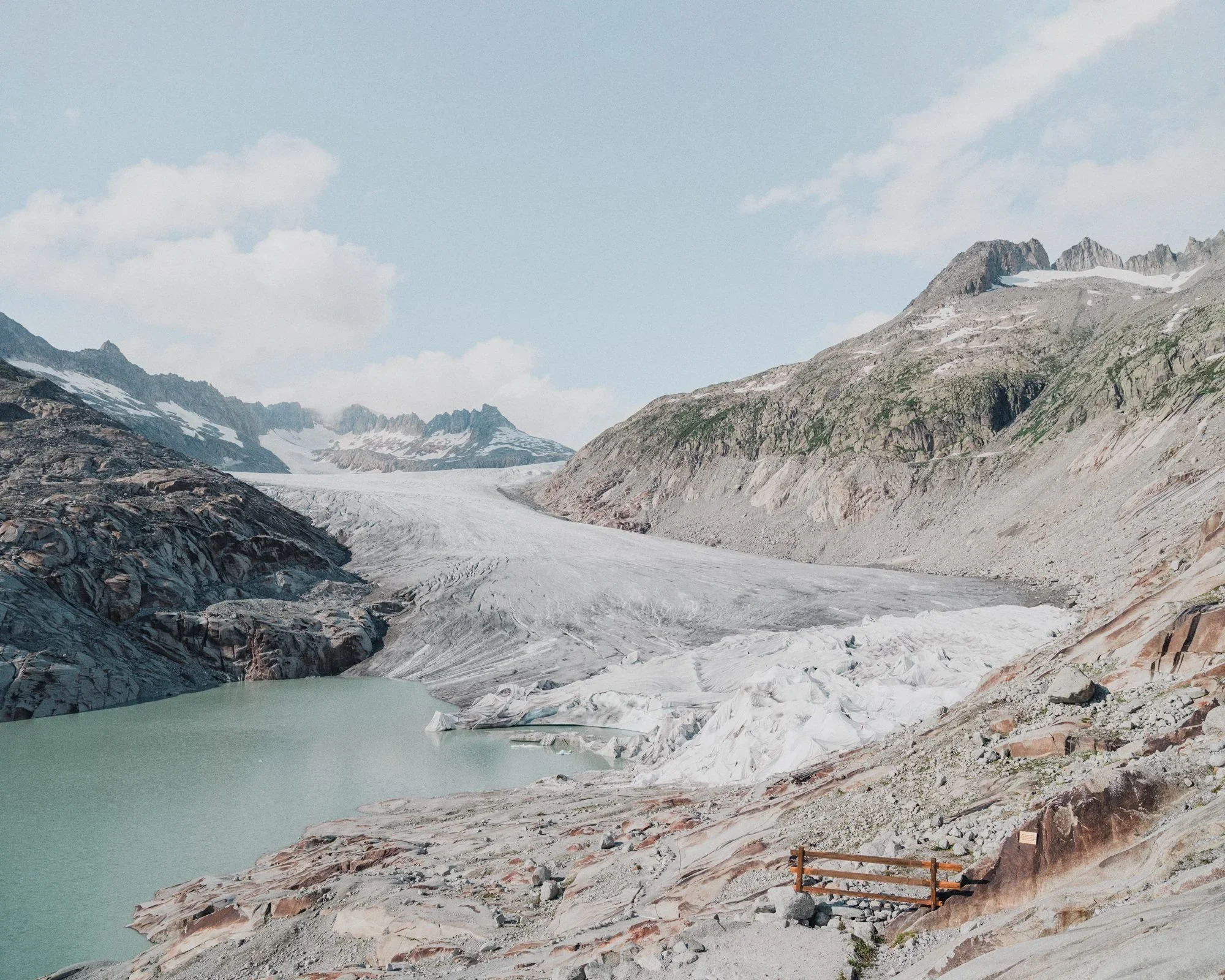
The Rhône Glacier appears without staging. There is no threshold, no dramatic build-up. It is simply there, massive, yet already fragile. The gaze encounters it like a body too large for the space it still occupies, already in the process of withdrawing. This is not a heroic landscape. It is a presence that persists, even as its disappearance is underway.
What strikes first is the calm. An almost administrative calm. The mountain is open, readable, devoid of apparent violence. The sky is clear, the light soft; nothing accelerates the viewing. And yet everything points to a silent urgency. The glacier does not collapse; it retreats. It slides out of the world as it once was. Slowness becomes a political fact. It imposes another rhythm on the eye, a stretched time in which disappearance is no longer an event, but a condition.
I returned to this place several times. Not in search of a more spectacular image, but to witness the continuity of that retreat. With each visit, the glacier seemed further removed from itself, as if its form persisted out of habit, out of inertia. The material remains, but its role has changed. It no longer structures the landscape; it testifies to it.
Facing it, human interventions appear almost indecent in their modesty. White sheets stretched over the ice attempt to slow the melting. A futile, almost absurd gesture, and yet a profoundly revealing one. We cover what is disappearing, as one covers a body, not to truly save it, but to postpone the moment when its loss must be accepted. This is not an act of domination. It is an admission. The admission of a civilization that no longer acts on causes, but on visible symptoms, at the scale of what it can still physically reach.
The image does not dramatize this contrast. It does not denounce; it observes. Glacier, rock, milky lake water, textile protections: everything coexists within the same plane, held at an equal distance. Nothing is hierarchized. The frame remains stable, frontal, almost neutral. This restraint is essential. It allows the place to act without commentary. What is shown is not a catastrophe in progress, but a transitional state that risks becoming permanent.
The Rhône Glacier is not presented here as a threatened natural icon. It is not sanctified. It is treated as an aging infrastructure, a structuring element of the territory that is gradually ceasing to function. Its disappearance is not romantic. It is technical, measurable, almost bureaucratic. It is managed. Covered. Documented. Watched as it melts at a pace compatible with our capacity to adapt.
What remains is a sensation of discrepancy. Between the geological scale of the phenomenon and the smallness of the responses deployed. Between the long time of the mountain and the short time of our decisions. This gap generates a quiet tension. Nothing shouts in the image. Nothing collapses. And it is precisely this absence of spectacle that makes the scene difficult to leave.
The photograph does not seek to warn. It does not propose a moral narrative. It allows a form of calm imbalance to emerge, almost polite. A landscape still functional, still accessible, yet already displaced from its original state. What we are looking at is not a distant future. It is a stabilized present, rendered acceptable by its very slowness.
Before the Rhône Glacier, time does not stop. It stretches. It forces one to remain, to look longer than expected, to accept that some things do not disappear in noise or rupture, but in a silent, organized, almost reasonable continuity. And that this manner of loss may say more about us than the loss itself.
