Civilization : Integrated Transit System, Chongqing, China
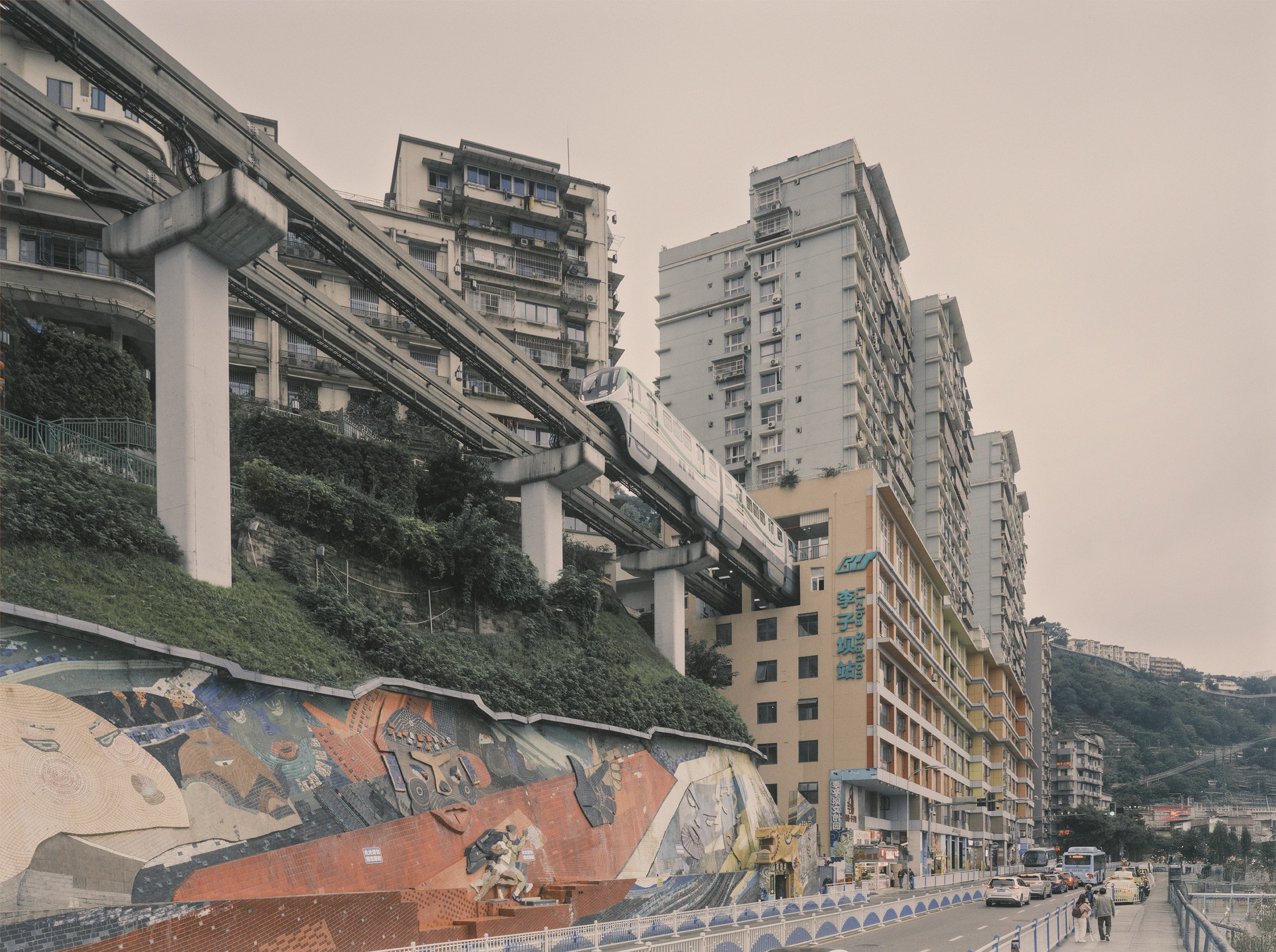
Chongqing — Urban Strata and Vertical Infrastructure

When I first encountered this site in Chongqing, what struck me was not the scale of the buildings, but the way the city seemed to lean into the mountain. Nothing here feels imposed from above. Instead, everything appears negotiated — rail, housing, vegetation, mural — each element adjusting to the constraints of terrain.

I stood at street level, looking up at the monorail sliding between residential towers and hillside growth. The train does not dominate the scene; it inhabits it. It passes quietly, suspended between structures, neither fully separated from daily life nor entirely absorbed by it. The infrastructure becomes domestic.

What interests me in this image is the layering. The mural on the retaining wall introduces representation into a space defined by circulation. It attempts to soften the concrete mass, yet it also reinforces the idea of construction as narrative. The city speaks about itself through surfaces.

Chongqing is often described as dense or overwhelming. My experience was different. I felt compression, yes, but also continuity. Vegetation threads through the built environment, filling seams and margins. It does not resist the city; it coexists within it.

The topography dictates movement. Growth here is vertical, diagonal, stratified. The mountain is not erased; it is engineered into the urban condition. What emerges is not a spectacle of development, but a landscape of integration — a system in which infrastructure, habitation and terrain are inseparable.

This photograph reflects my ongoing interest in spaces where civilization does not replace the natural environment, but reorganizes it. The city becomes a layered terrain, a hybrid condition shaped by necessity rather than idealization.


Chongqing — Strates urbaines et infrastructure verticale

Lorsque j’ai découvert ce site à Chongqing, ce qui m’a frappé n’était pas l’échelle des immeubles, mais la manière dont la ville semblait s’appuyer sur la montagne. Rien ici ne paraît imposé de manière autoritaire. Tout semble négocié — le rail, l’habitat, la végétation, la fresque — chaque élément s’adaptant aux contraintes du relief.

Je me tenais au niveau de la rue, observant le monorail glisser entre les tours résidentielles et la végétation de la colline. Le train ne domine pas la scène ; il l’habite. Il traverse l’espace suspendu entre les structures, ni totalement séparé de la vie quotidienne, ni complètement absorbé par elle. L’infrastructure devient domestique.

Ce qui m’intéresse dans cette image, c’est la superposition. La fresque sur le mur de soutènement introduit une dimension narrative dans un espace défini par la circulation. Elle tente d’adoucir la masse de béton, tout en rappelant que la construction elle-même devient récit. La ville parle à travers ses surfaces.

Chongqing est souvent décrite comme dense, voire écrasante. Mon expérience fut différente. J’y ai ressenti une compression, mais aussi une continuité. La végétation s’insinue dans le tissu bâti, occupe les interstices, relie les éléments. Elle ne s’oppose pas à la ville ; elle coexiste avec elle.

Le relief conditionne les mouvements. La croissance ici est verticale, diagonale, stratifiée. La montagne n’est pas effacée ; elle est intégrée à la condition urbaine. Ce qui émerge n’est pas un spectacle du développement, mais un paysage d’intégration — un système où infrastructure, habitat et topographie deviennent indissociables.

Cette photographie prolonge ma recherche sur les espaces où la civilisation ne remplace pas le milieu naturel, mais le réorganise. La ville devient un terrain composite, une condition hybride façonnée par la contrainte plus que par l’idéalisme.

Next
Next

Civilization : Glacier Cover, Switzerland