Soviet-Era Paintings, Cultural House of the Institute for Physical Research, Ashtarak, Armenia, 2024
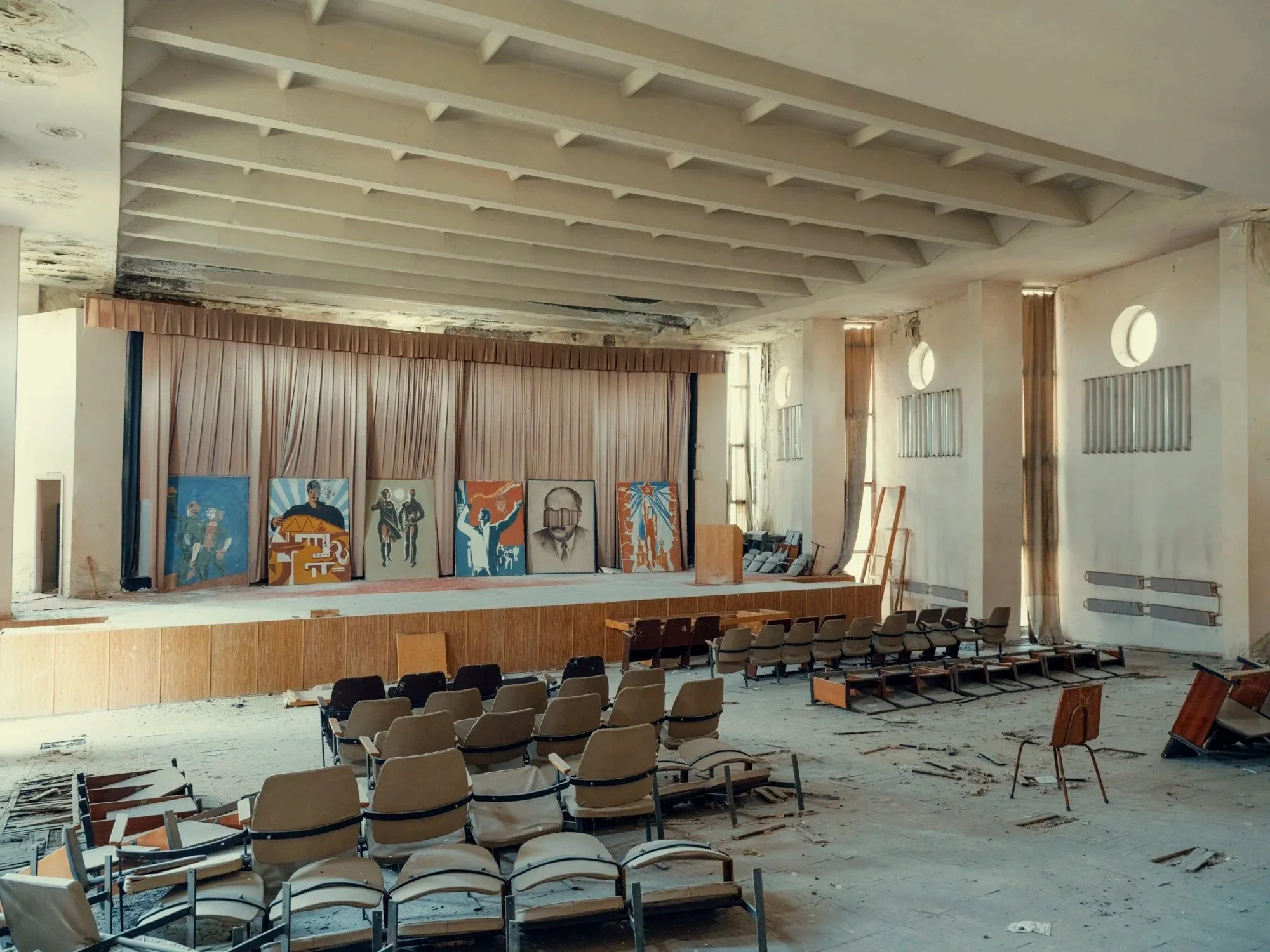
I pushed the door of the Institute of Ashtarak into the heart of this Armenia where the mountains still seem to bend under the Soviet silence. Beyond the laboratories and equations, I discovered a place frozen in an in-between time: its House of Culture.
When I enter this conference room, the air is heavy with this century-old dust that stings the throat, and yet, the scenery seems to be waiting for a signal for the session to resume.
On the stage, aligned like fallen sentinels, six paintings from the Soviet era seemed to stare at me in the darkness of the deserted room. In the center, Lenin. Her flaked face, almost erased by time, made me dizzy: it’s as if the story itself had tired of its own myth.
My gaze is inevitably drawn to the rigorous geometry of the ceiling, whose massive concrete beams impose a repetitive rhythm that clashes with the chaos at my feet. At the bottom, the rows of wooden seats are in full disarray, knocked over or torn off. Light falls surgically on this devastated interior, highlighting the texture of the worn linoleum and the debris that litter the floor.
It is this contrast that upset me: at the top, the immutable order of science; at the bottom, the chaos of abandonment. The seats torn off, lying on the ground as if after a struggle, gave me the impression of arriving just after a disaster that no one would have survived to witness.
In front of this empty desk, it was no longer just the exploration of a building, it was the brutal confrontation with the end of a utopia. The time of a few triggers, I was no longer a simple visitor, but the depositary of a secret: that of a world where art and science had sworn loyalty, before dying of solitude in the silence of Ashtarak.
